
Introduction
The landscape of Engineering, Procurement, and Construction (EPC) sector is evolving, requiring new approaches to project delivery. As global infrastructure, petrochemical, and Oil & Gas projects become more complex and cost-sensitive, traditional project delivery methods are proving inadequate. AI and digital transformation have emerged as key enablers of efficiency, predictability, and cost control in large-scale projects across these industries.
According to McKinsey’s Rewired:1 The McKinsey Guide to Outcompeting in the Age of Digital and AI, successful digital transformation depends on six enterprise capabilities. Among these, delivery capabilities stand out as the key to ensuring project success, encompassing process automation, organizational agility, and the effective use of data and analytics.
From large-scale infrastructure projects to complex petrochemical and Oil & Gas developments, efficient project delivery is crucial to meeting cost, schedule, and risk management expectations. This article explores with focus on how Contractors, Integrators, and Vendors in all EPC sectors can leverage AI to transform delivery capabilities, ensuring projects are executed on time, within budget, and with minimal risk and key ML to support the transformation.
The Power of Delivery Capabilities in EPC
While successful project execution depends on multiple factors, delivery excellence is what ensures efficiency across all major stakeholders in an EPC project
1. Contractors: AI-Powered Cost Management and Predictive Analytics in EPC Projects
EPC contractors are responsible for executing projects within specified budgets and timelines. However, cost overruns remain a persistent challenge due to unforeseen risks, inefficient planning, and evolving market conditions. AI-powered models help mitigate these risks by analyzing historical project data, market trends, and real-time variables to predict cost deviations before they occur.
A key component of this approach is the seamless integration of lessons learned from past projects, allowing for proactive risk mitigation and budget optimization. AI-driven models play a crucial role in this process:
- Machine Learning Models (Gradient Boosting, Random Forests, Neural Networks): Improve budget accuracy by identifying cost-driving factors and predicting overruns.
- Risk Assessment Models (Bayesian Networks, Markov Models, Monte Carlo Simulations): Assess uncertainties and provide probabilistic risk analysis for informed decision-making.
- Natural Language Processing (NLP) Models (Transformers, Topic Modeling): Extract insights from past project documentation, ensuring lessons learned are applied effectively.
- Real-Time Analytics & Optimization (Reinforcement Learning, Anomaly Detection, Genetic Algorithms): Enable dynamic cost control, procurement optimization, and proactive risk identification.
By leveraging these AI-driven approaches, EPC contractors can enhance cost efficiency, prevent budget escalations, and improve overall project execution.
2. Integrators: Overcoming Time, Compatibility, and Testing Challenges
System Integrators manage multiple projects simultaneously, facing challenges such as delays, cost overruns, system compatibility issues, and stringent testing requirements. AI enhances transparency across departments by providing real-time insights into project progress, integrating technical requirements, and ensuring seamless execution. Various AI models address these challenges effectively:
- Supplier & Contract Optimization (Reinforcement Learning, Decision Trees): Automates supplier assessments, optimizing contract negotiations and procurement strategies.
- Demand Forecasting (Time-Series Models, Gradient Boosting, Neural Networks): Predicts optimal order timing to prevent cost inflation and supply chain disruptions.
- Compatibility Testing & Simulation (AI-driven Anomaly Detection, Bayesian Networks, Digital Twins): Identifies potential integration failures before deployment, ensuring seamless system interoperability.
- Predictive Time Management (Monte Carlo Simulations, Markov Models, Constraint Optimization): Enhances scheduling efficiency by identifying bottlenecks and optimizing resource allocation.
By leveraging AI-powered predictive analytics and automation, system integrators can streamline workflows, reduce risks, and improve overall project efficiency.
3. Vendors: AI-Powered Deliverables and Scheduling
Vendors play a critical role in ensuring timely delivery of materials and equipment. Traditional project scheduling relies on static Gantt charts and human estimations, often leading to unexpected delays. AI-powered models enhance scheduling efficiency by leveraging real-time data, workforce availability, and supply chain dynamics.
- Dynamic Scheduling Optimization (Reinforcement Learning, Constraint Optimization, Neural Networks): AI-driven scheduling tools enhance project timeline accuracy by dynamically adjusting for delays and disruptions.
- Automated Workforce Allocation (Genetic Algorithms, Decision Trees): Optimizes on-site productivity by intelligently assigning resources based on demand and skill availability.
- Disruption Prediction (Anomaly Detection, Bayesian Networks): Identifies supply chain risks and potential delays before they impact project timelines.
- Demand Forecasting & Waste Reduction (Time-Series Models, Gradient Boosting): Aligns vendor deliverables with actual project needs, minimizing material wastage and cost overruns.
By integrating AI into scheduling and supply chain management, vendors can enhance reliability, reduce inefficiencies, and ensure seamless project execution.
4. Safety and Compliance for All Stakeholders
Worksite safety and regulatory compliance remain critical challenges for Contractors, Integrators, and Vendors. AI-powered monitoring systems enhance safety protocols, provide real-time alerts, and ensure adherence to industry regulations, minimizing risks and operational disruptions. Various AI models contribute to these improvements:
- Real-Time Monitoring & Reporting (Computer Vision, IoT-Enabled AI, Anomaly Detection): Provides automated performance insights, real-time safety alerts, and progress tracking.
- Hazard Detection & Safety Training (Deep Learning, Object Detection Models – YOLO, Faster R-CNN): Identifies potential hazards on-site and enhances safety training through AI-driven simulations.
- Compliance Tracking & Regulatory Adherence (Natural Language Processing, Rule-Based AI Systems): Automates compliance verification, reducing the risk of regulatory penalties.
- AI-Powered Audits & Incident Management (Knowledge Graphs, Predictive Analytics, Reinforcement Learning): Ensures faster resolution of safety incidents by analyzing historical data and optimizing response strategies.
- Proactive Risk Mitigation (Bayesian Networks, Monte Carlo Simulations, Time-Series Forecasting): Predicts potential risks and enables preventive measures to enhance overall worksite safety.
By integrating AI-driven safety and compliance solutions, stakeholders can reduce workplace incidents, improve regulatory adherence, and create a safer, more efficient project environment.
The Future of AI-Driven Delivery in EPC
AI is no longer a luxury but a necessity for EPC firms looking to stay competitive. Companies that fail to adopt AI-driven delivery capabilities risk falling behind, while those that integrate AI will see significant gains in efficiency, cost control, and risk mitigation.
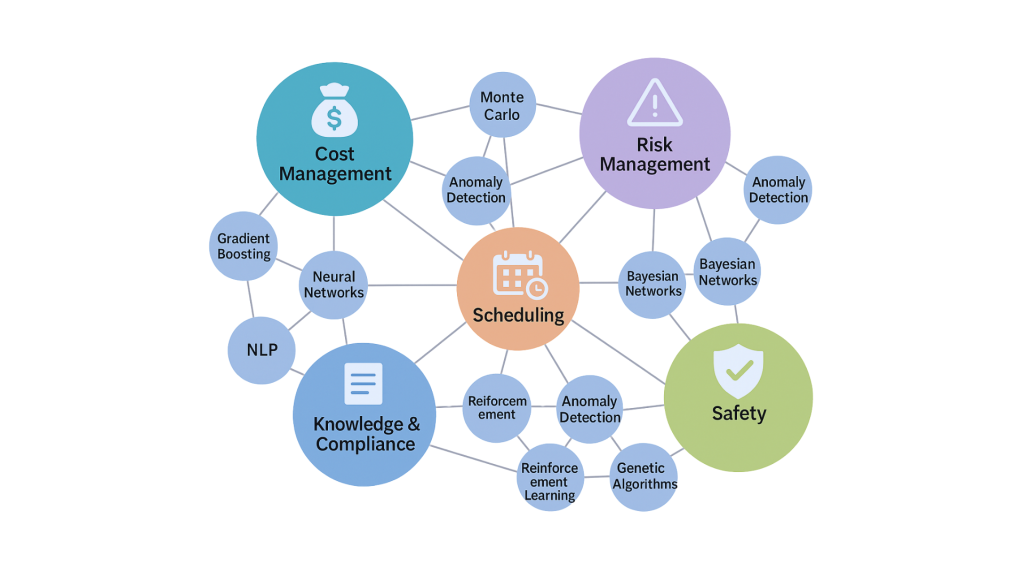
Key Machine Learning Methods and their Impact on Delivery Excellence
Final Thought: Are You Ready to Reimagine Your Delivery Model by embracing the AI revolution or will you stick to the status quo?
The EPC industry’s future belongs to firms that embrace AI and digital transformation to drive efficiency, reduce costs, and mitigate risks. Embracing AI in major projects and entities involved in it, requires a shift not just in technology but in leadership, employee mindset, and organizational agility. Companies must foster an AI-first culture where data-driven decision-making, cross-functional collaboration, and continuous learning become the norm.
Resources
- Rewired: A McKinsey Guide to Outcompeting in the Age of Digital and AI (Wiley, June 20, 2023) ↩︎